
The links to the respective websites
for concepts Ia to IX can be found here:
(Each page has its own table of contents)

Theme Ib Individual transport using cable car and rail technology
Content of this page:
- Interview and membership with Zukunftsmacher (Future Makers)
- Statistics on today's passenger transport
- Examples of yesterday's private transport for tomorrow
- The goals and requirements for future private transport
- The video for the new transport system
- Photos of models
- Description of the cable car rail system of the future
- The cable car rail system for small communities or districts
- System description of the future cable car rail system
- Cable car rail system for rural areas and freight transport
- Summary of the new cable car rail system
- Safety of cable cars
- Video of a planned cable car
- Sustainability of cable cars
- Existing cable car systems in operation (Link to website)
- General information on magnetic levitation and cable car rail systems (Link to website)
JM 15.02.2026
1. Interview and membership with the Zukunftsmacher (Future Makers)
Die ZukunftsMacher interviews the SIV Dipl. Ing. J. Mülders initiative on the topic: Why an engineer wants to move mobility into the air.
JM 22.08.2025
2. Statistics on today's passenger transport
2.1 Statistics on current use of transport modes

The new cable car rail system will be able to accommodate private and public transport if we want it to.
These statistics clearly show the problem area. Public transport systems are hardly in a position to accommodate these 45 billion kilometres, let alone provide an adequate level of
service.
There will be no solution either through voluntary restraint or coercion.
2.2 Statistics on the dominance of the car
Europe:
Road traffic: Cars continue to dominate.
Some current data on:
- Motorised private transport,
- Number of cars and their age,
- Registration of combustion engines,
- CO2 consumption and road deaths
JM 25.12.2025
2.3 Accident statistics in Europe (Vision Zero as a goal?)
The EU has a good track record on road safety
but every road death is one too many.
Find out more about the figures by country, age and gender.
Published: 15-04-2019
Last update: 17-10-2025 - 13:17

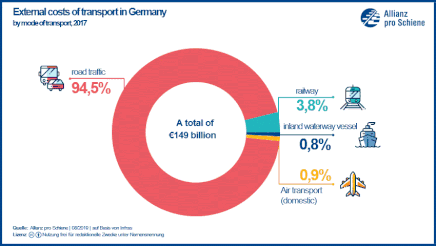
2.4 External costs of transport in Germany
An overview and link to the Pro-Rail Alliance. These costs are often overlooked in many assessments, especially for ideas such as a cable car-rail system. The roads are already there anyway.
JM 09.02.2026
3. Examples of yesterday's private transport for tomorrow
These were ideas from 1970 to 1980 in Hagen.
But, unfortunately, nobody wanted them.
What a shame!
4. The goals and requirements for future private transport
- Enable private vehicles,
- Enable public vehicles,
- No accidents Vision Zero, safe driving,
- Comfort similar to today's cars,
- Long service life of vehicles,
- Always available, 24/7, including public vehicles,
- Many accessible stops, theoretically in front of every door,
- Global solution, can be used in all countries,
- no need to change from your front door to your destination,
- all roads must theoretically be accessible, solution provided on site,
- fast,
- no traffic jams, no traffic lights,
- climate-neutral, no noise, no exhaust fumes, no particulate matter,
- car-free roads, space for footpaths and cycle paths,
- green roads for cooler temperatures,
- habitable and playable streets,
- no searching for parking spaces, done autonomously,
- no refuelling, no charging, done automatically when parked,
- autonomous driving,
- rural areas must be quickly accessible,
- individual construction, street by street,
- today's cars must be able to be transported and enter and exit at many stops.
JM 15.02.2026
5. The video for the new transport system
5.1 New video model of the cable car track system, approx. 3.50 m long
still in German; English version in progress

This new video shows a model of an urban street nearly 300 meters long. It features transfer points where today’s vehicles connect to the cable-rail system, a double intersection, a double stop,
crossings over railroad tracks or rivers, and similar features with elevators and inclined elevators, as well as a building with an interior stop. It could also be a parking garage or a school.
Even trucks and buses can be transported within the system.
If today’s infrastructure costs were applied to this system, we would soon have a climate-neutral transportation system.
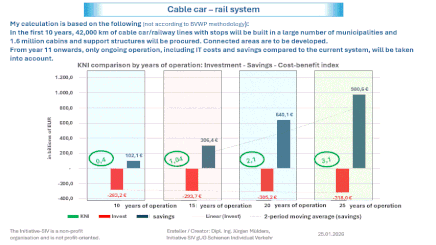
5.2 Video of a model of the cable car rail system

all details and calculations similar to the cost-benefit index analysis.


-
5.3 Video of a bus stop and an intersection
Crossings are important components for reaching all roads.
The new barrier-free stop with cable car rail technology. This is where the cabins or support frames for today's vehicles come down for boarding and alighting.
Switches have long been in use for railways and are not shown here separately.
6. Photos of models
The cabins or support frames are lowered using elevator technology.
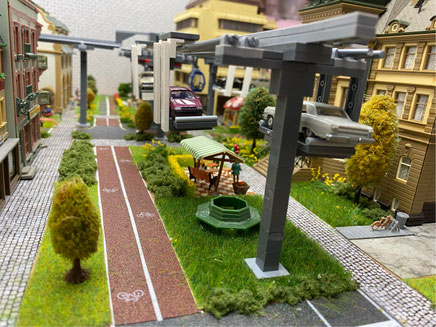
Car-free green street, traffic drives one level higher.

Small, barrier-free stop. Traffic continues to flow above.

Safe footpaths and cycle paths.
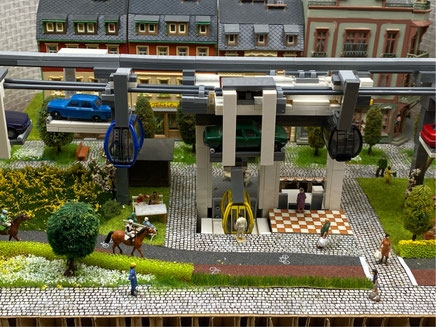
There is time at the bottom to get on or off at your leisure.
JM 28.01.2025

The stop can also be relocated inside buildings.
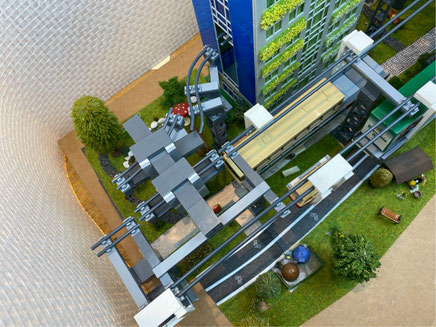
Buildings can also be parking garages.
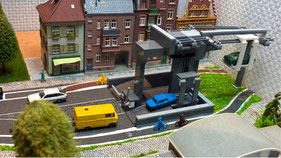
The transfer station from today's roads to the cable rail system. As with stops equipped with elevator systems.
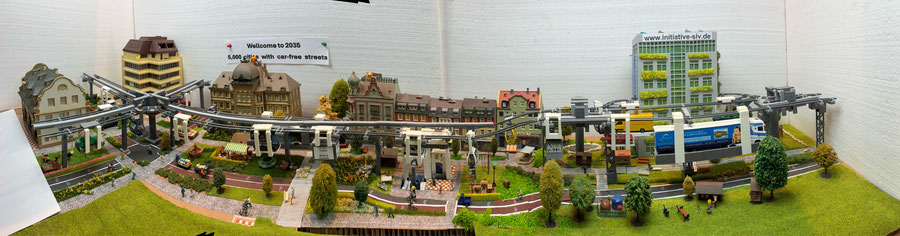
The panoramic image of the models, which can also be seen in the video.
7. Description of the cable car rail system of the future
a. The ropes, rails
- Ropes or rails are stretched from support to support at a height of approx. 4 m to ensure that fire trucks can pass through. But not much higher than that.
- The rails are used to build the switches, curves, and intersections.
b. The cabins
- The cabins have their own electric drive system, including brakes, which is powered by batteries. Solar cells are installed on the roof to generate electricity. These can be charged autonomously in garages and parking garages.
- The cabins are controlled centrally by AI according to user requirements.
- There are both public and privately owned cabins.
- The number of people per cabin is adjusted according to demand, as is already the case today.
c. Carriers
- The support frames have the same drive system as the cabins.
- The support frames are designed for our current passenger cars.
- The arrival and departure of passenger cars at stops is planned according to demand. It is also possible to leave the car at the stop and send it to a parking garage. Later, it can be ordered to any stop via an app.
d. The stops
- The stops are kept very small and can be quickly assembled and dismantled as prefabricated parts as required.
- Many stops can also be set up, e.g., at train stations, as required. Cars should not be able to enter or exit here.
- To allow passengers to board and alight, the cabins slow down to a standstill on a special section of track. The rail with the cabin is lowered using an elevator system. A second rail closes the gap so that the following cabins can pass.
- The same applies to the support frames.
- Stops on private property, e.g., company premises or school grounds, are also possible. The security systems for the entrances will be coordinated.
- In terms of time, it is faster than subways or elevated railways, where you first have to get out, walk to the elevator or stairs, and possibly wait to get to the normal level. Here, you can get out at your leisure and are already at the normal level.
- If the cable car rail system is connected to hospitals and fire stations, emergency vehicles can also use the system. In this case, all vehicles are automatically moved out of the way for the emergency vehicles on their way to their destination, and then continue on to their destination. The emergency vehicles are now faster and safer without sirens, as they also drive autonomously with appropriate prioritization. At their destination, the vehicles can be lowered anywhere using cable systems.
This list is a draft that requires further adjustments, which will be made on an ongoing basis.
15.02.2026
8. The cable car rail system for small communities or districts
An elevator system transfers vehicles from the road to the cable-rail system at the town entrance or exit using parking robots. (These robots slide under the vehicles, lift them by the tires, and
autonomously move them onto or off the support frames. The existing roadway ends here and is then converted into a pedestrian- and bicycle-friendly street.)
All vehicles now travel through or into the town in a climate-neutral manner. Stops can be installed as desired. This means that this district is now completely climate-neutral and has habitable
streets.
JM 16.05.2026
9. System description of the future cable car rail system
Innovative cable car rail system for the transport of the future
The new barrier-free cable car rail system is designed to connect key parts of the city center, the outer districts, and commercial areas. This system will offer both on-demand
public transport and individual trips in private cabins. Similar to cars, the private cabins can be equipped according to customer requirements.
The cabins will travel autonomously on fixed steel cables or rails using their own electric motor and battery. When not in use, the batteries can be charged in parking
garages. Electric 40-ton trucks already have a range of approximately 500 km. The plan for the cable car rail system of the future includes several special features and challenges:
Flexible route network: The system will have curves, intersections, and switches so that it can access almost all streets directly and without transfers. It will run at a height of approximately 4 m (to allow passage for fire trucks, for example) through today's public streets.
- Barrier-free stops: Access at the stops will always be barrier-free and at ground level. This is made possible by the design of the stops, where the cabins are lowered to allow passage above. The advantage is that the stops can be kept very small (like a car) and there is sufficient time to get on and off. Furthermore, the stop locations can be adapted to demand.
- Material transport: In addition to passenger cabins, it should also be possible to transport our current cars in special carrying frames. This makes it possible to completely free the roads from car traffic without having to introduce new vehicles. Today's vehicles can be transported with passengers in an environmentally friendly manner without traffic jams and traffic lights. Cars can be loaded and unloaded at the above-mentioned stops. (see VW plant in Bratislava)
- Intelligent control: Trips are coordinated using an app and AI, similar to baggage systems at airports.
- Autonomous parking spaces: Unused vehicles drive autonomously to deserted parking garages, where they can also be charged.
The aim of this project is to make private transport more climate-friendly without imposing restrictions. Traffic accidents will be prevented (Vision Zero) and the now car-free streets can be
largely unsealed to make room for green spaces and pedestrian and bicycle traffic.
This cable car-rail system of the future will provide a revolutionary solution to make all transport more efficient and environmentally friendly for a people-friendly city with car-free streets.
Transporting today's vehicles will enable a smooth transition or changeover without sacrifice or prohibitions.
10. Cable car rail system for rural areas and freight transport
10.1 High-speed cable car rail system in rural areas
Let's let our imagination run wild and think about Phantasialand or a similar amusement park. There we experience fascinating roller coasters in a wide variety of designs – suspended, standing,
fast or leisurely.
Let's focus on the standing systems, because they give us a feeling of safety – we ride on a solid track and are not suspended in the air.
Now let's switch back from the world of adventure to our everyday world of transportation – and take the idea with us.
Let's imagine combining the cable car track technology, which already runs at a height of around 4 meters in cities, with the proven track technology of roller coasters. This creates a new type
of transportation system:
The cabins now start smoothly and can reach speeds of over 100 km/h – without the typical jolting or swaying. (The Silver Star at Europa-Park and the Schwur des Kärnan at Hansa-Park both travel
at speeds of up to 127 km/h). As with modern high-speed rail lines, the curve radii, gradients, and inclines are adjusted to ensure a smooth and comfortable ride (drink test). This means that
even longer distances between cities and towns can be covered quickly, safely, and in a climate-neutral manner. The municipalities themselves decide which routes to expand.
Since the entire system is located at a height of approximately 5 meters, almost no additional space is sealed—only the space for the support structures is required.
JM 15.02.2026
This opens up a whole new chapter in transportation design
between communities with higher speeds:
climate-neutral, safe, and quiet personal transportation that rises above the landscape—
inspired by roller coaster technology, but made for our everyday lives.
10.2 Cable car rail system for freight transport (trucks)
Similar solutions are conceivable for freight transport and heavy truck transport, as the differences in weight have long been technically manageable.
With this new cable car-rail system, trucks or their trailers can travel independently of individual traffic to the new freight stations described in Topic III – More Freight on Rail and
autonomously enter the wagons there.
This would also allow the route from the industrial park to the rail loading point to be realized completely autonomously and without additional land sealing.
JM 15.02.2026
10.3 Cable-rail system for inclines and gradients
For routes with inclines and gradients, inclined lifts are a possible solution. In this case, the cabins or support frames are to be placed autonomously onto the inclined
platform.
Examples include the Leitner ConnX – a cable car-vehicle hybrid – and the cable car-road vehicle combination from Aachen.
See:
15. Existing cable car systems in operation (Link to website)
Please use the browser's translation feature.
11. Summary of the new cable car rail system
Introduction
We present an innovative concept for promoting sustainable and climate-neutral mobility in urban areas, as connections in rural areas, and for freight transport through the use of
a new cable car-rail system. The idea is aimed at revolutionizing public and private individual transport and shaping an environmentally friendly future.
The challenge of climate change and mobility
The current challenges posed by climate change require a drastic change in how we approach mobility, as the transport sector contributes significantly to greenhouse gas emissions.
To meet these challenges, we need to rethink our approach and make greater use of innovative technologies to find sustainable solutions.
The concept of the new cable car rail system
The proposed solution is based on the use of a new cable car rail system in which vehicles, both public and private, float at a height of around 4 meters above specially designed tracks. Our
current vehicles can also float on support frames, similar to a car transporter, using this system. This creates a smooth transition between the current and future transport systems.
This technology enables smooth traffic flow, minimizes the amount of floor space required, and significantly reduces energy consumption. It also offers greatly improved comfort and is completely
barrier-free.
Advantages of the new cable car rail system
This technology offers a wide range of advantages. First, it significantly reduces the space required for traffic, as the vehicles float in the air. Car-free streets are now possible. This
creates space for more green areas, pedestrian zones, and bike paths, resulting in a more livable environment.
Secondly, the use of electric drives for these cabins and support structures is an integral part of the concept. Since only the vehicles in use are powered and not the heavy cable, as is the case
with normal cable cars, operation is very economical. The use of renewable energies as a power source means that there are no emissions on site, which makes a significant contribution to reducing
the carbon footprint.
Thirdly, increased mobility in the third dimension enables faster and more efficient travel within the city. This leads to less congestion and time savings for all citizens.
Implementation and collaboration
Implementing this visionary concept requires investment in research, infrastructure, and collaboration between government, scientists, industry, and the community. Only through joint efforts can
we further develop and optimize this technology and make it accessible to everyone.
Conclusion
It is within our power as a society to shape a sustainable future. By working together and implementing innovative ideas such as the cable car rail system of the future, we can create
climate-neutral mobility for our cities. Let us work together on this visionary dream and shape an environmentally friendly future.
Many more adjustments and innovations are still possible.
12. Safety of cable cars
International meetings of technical authorities for cable cars (ITTAB) are held annually. In 2023, the meeting took place in Hong Kong. The main focus of these meetings is to report on accidents and exchange experiences. Twenty-nine delegates from 13 countries were in attendance.
-
A global analysis of cable car accidents from 1939 to 2024 shows that 446 people were killed. However, not all countries report relevant data. The most serious accident occurred in Kaprun in
2000, when 155 people died in a fire in the tunnel.
By comparison, 2,839 people died in traffic accidents in Germany in 2023.
JM 09.01.2025
13. Video of a planned cable car
Video of the Wälderbahn railway of the future.
From minute 3 onwards, the route begins in an urban area.
Unfortunately, this railway was never built.
JM 12.04.2025
14. Sustainability of cable cars
Sustainability – Cable cars have several lives
A description of the company
Seilbahnen International Verlag GmbH
A-5301 Eugendorf/Salzburg
JM 13.02.2026
15. Existing cable car systems in operation (Link to website)
Contents of the following page:
- Different existing cable car systems
JM 12.04.2025
16. General information on magnetic levitation and cable car rail systems (Link to website)
Contents of the following page:
- Possible ecological materials for the construction of rail systemsFinancing and schedule
- Economic costs of traffic accidents in Germany from 2005 to 2022
JM 02.04.2025
If you find any errors, we would be grateful for any feedback.