
The links to the respective websites
for concepts Ia to IX can be found here:
(Each page has its own table of contents)

Subtopic Ib-1 Examples of different ropeways
Content of this page:
-
A look at the history of ropeways
- Examples of different ropeways
JM 22.07.2025
1. A look at the history of ropeways
The first ropeway was built in 1644, see start page.
Mining ropeways around 1900-1930: Present everywhere because they were efficient, robust and cost-effective - often covering kilometres. They could be set up and dismantled quickly.
There were even curved guides - technically solved, even if it was only for buckets.
Here is a look at the history of ropeways in mining:
JM 22.07.2025
2. Examples of the different ropeways
2.1 Types of cable cars
Here is a link to a description of the different types of cable cars. (Company Leitner, Austria)
2.2a Cable car garages
Here is a link to a description of a garage system for cable cars. Here the number of cabins can be adjusted according to demand so that there are always enough cabins in the system.
Curves and switches can also be recognised here.
(Leitner company, Austria)
2.2b Cable car garages (Bertholed)
The Ropetaxi (Bertholed) also shows the switch system for the garages from sec. 60.
2.3 Ropeways for cars
Here is a video of how cars are transported by a cable car at the VW plant in Bratislava.
2.4 Ropeway combination with self-running railway
The forest railway of the future, City-Cabel-Car
(planned between Dornbirn and Bersbuch Austria)
shows a combination of cable car with a self-propelled rail-guided railway with the same cabin without changing trains.
Description from Sec: 3.08.
2.5a Ropeway combination with road vehicle
The companies ConnX and Leitner are currently testing the automatic transfer of cable cars to a vehicle and vice versa. This vehicle may also be able to drive autonomously for the final stretch.
2.5b Ropeway combination with road vehicle (Aachen)
A similar combination has been developed by RWTH Aachen University, here is the video.
2.6 Elevator - railway combination
There's no end to what you can do here - a lift is combined with a rail vehicle without having to change trains.
2.7 Ferries with overhead lines
Here is a description from Wikipedia about overhead lines in shipping traffic
2.8 Ropeways with 3 ropes, 2 fixed ropes and one hauling rope
The Peak 2 Peak Gondola is a 3S lift that was built in 2007 and 2008 by the Doppelmayr/Garaventa Group. The 28 detachable gondolas for 28 passengers each (22 seated, 6 standing) are suspended from two permanently installed suspension ropes and are moved at a speed of up to 7.5 m/s (27 km/h) by an evenly circulating, endlessly spliced haul rope.
2.9 Self-propelled ropeways
I found self-propelled ropeways at the Otto railway.
2.10 Port - Personal Overhead Rapid Transit
The ropeway system shows good ideas for the vertical lowering of cabins and a perfect ride past stops.
2.11 Cable car carries refuse collection vehicle up the mountain
A cable car carries a garbage truck and supplies an entire community and tourists with everything they need to live. There are no roads to the community.
2.12 Ropeway for heavy loads
Such heavy-duty cableways are often used for large construction sites in the mountains.
Sec.: 2:41 an example
2.13 Ropeways for large construction sites
The company Seik shows special ropeways for construction sites, which can handle large weights but also areas with traverse ropeways. Click here for the website:
JM 21.10.2024
2.14 Self-driving underground railway
Es gibt seit Jahrzehnten Selbstfahrende U-Bahnen, z.B. Nürnberg, Kopenhagen
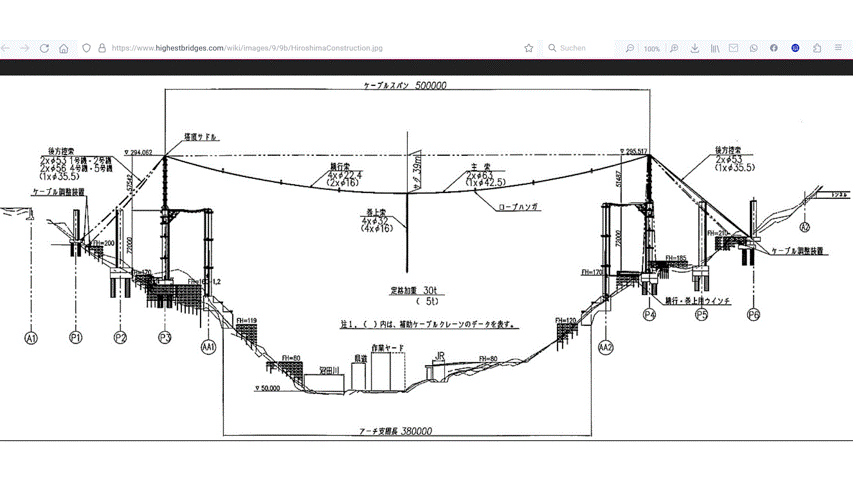
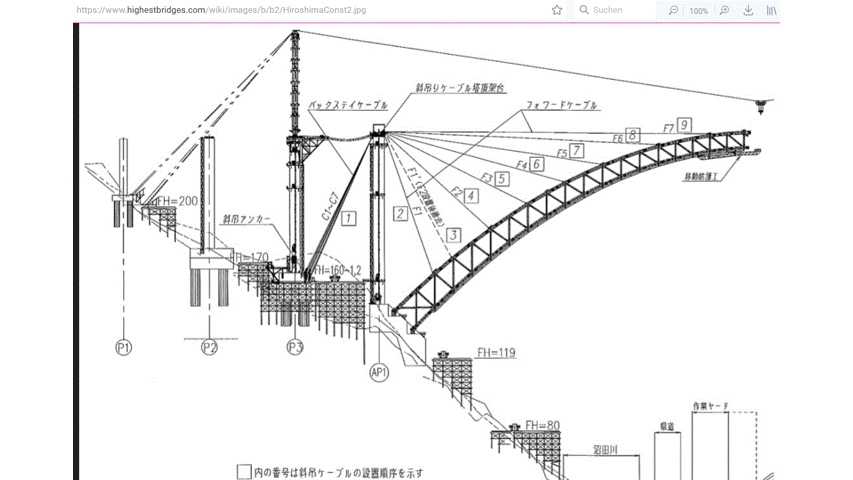
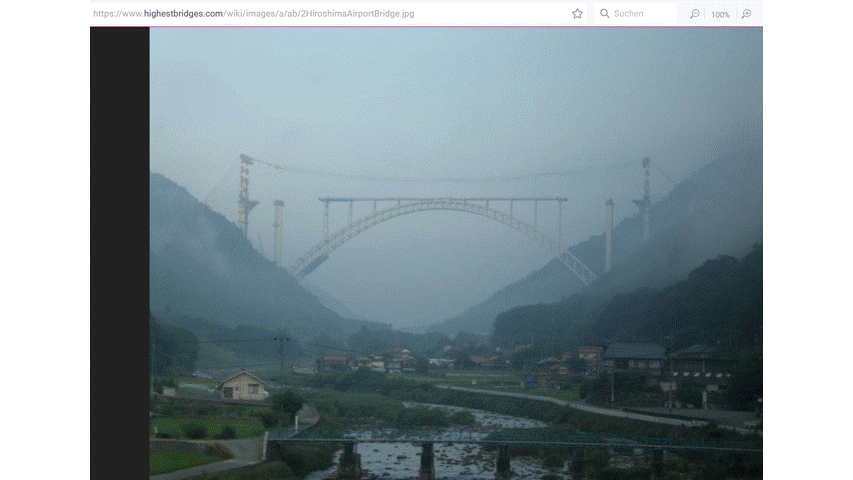
2.15 Pictures of the construction of Hiroshima Airport


If you find any errors, we are grateful for any advice.