
My various sustainable future transport concepts

The links to the respective websites
for concepts Ia to IX can be found here:
(Each page has its own table of contents)
Link to overview of climate protection court rulings,
Federal Court of Justice, International Court of Justice, Federal Administrative Court
Award presented to the SIV gUG initiative by diind
On June 4, 2026, the German Innovation Institute awarded the
SIV gUG initiative the title of “Company of the Future”:
Visionary transportation solutions for climate-neutral mobility
The SIV Schienen Individual Verkehr gUG (limited liability) initiative has been awarded the “Company of the Future” seal by the German Institute for Innovation in Sustainability and Digitalization (diind). With this award, the institute recognizes the nonprofit organization’s exceptional commitment to developing innovative transportation concepts that pave the way for climate-neutral, barrier-free, and efficient mobility.
The “Company of the Future” seal recognizes organizations that view sustainable practices not as a short-term trend, but as an integral part of their social mission. In a multi-stage evaluation process, diind analyzes, among other things, a company’s digital presence, innovative strength, and forward-looking approach. The SIV initiative performed well in all evaluated areas and has positioned itself as a forward-looking partner for a sustainable transportation transition.
The SIV Initiative develops visionary transportation solutions that shift private and public transportation to a cable-rail system—barrier-free, autonomous with AI control, and direct from start to finish without transfers or traffic jams. The result: car-free streets, more green spaces, and quality of life instead of traffic noise and exhaust fumes. All the necessary technologies already exist on the market but have not yet been combined in this way.
JM 05/06/2026
Companies of the Future:

A solution to mobility and transport problems is possible in the near future
This new video shows a model of an urban street nearly 300 meters long. It features transfer points where today’s vehicles connect to the cable-rail system, a double intersection, a double stop,
crossings over railroad tracks or rivers, and similar features with elevators and inclined elevators, as well as a building with an interior stop. It could also be a parking garage or a school.
Even trucks and buses can be transported within the system.
If today’s infrastructure costs were applied to this system, we would soon have a climate-neutral transportation system.
still in German; English version in progress


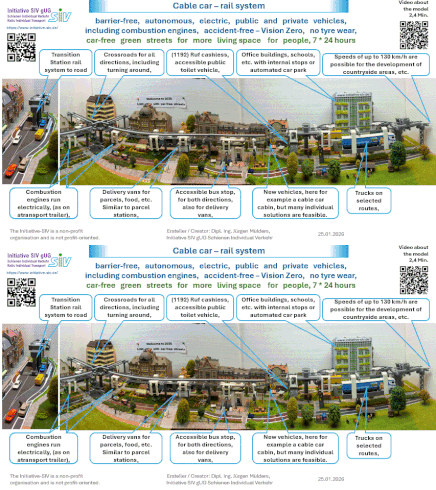
The mobility of the future, today. Without restrictions or sacrifices, private and public transport will be relocated to a height of approx. 4-5 meters using a
cable car rail system. There will be car-free streets with green spaces and more room for quality of life. With this barrier-free, autonomous solution, journeys will now be made directly from
start to destination without changing trains and without traffic jams, using AI control. There are no exhaust fumes, no tire wear, and no traffic noise. The small, needs-based stops allow for
level entry and exit without time pressure, as traffic can continue to flow above the stop. The dimmable windows of the vehicles can be switched to opaque mode if necessary. Special motors enable
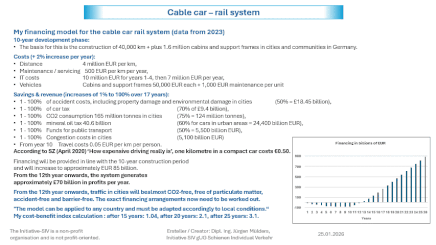
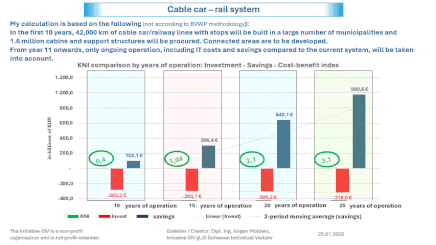
speeds of up to 100 km/h for longer distances. After approximately 10-15 years, the system will generate profits through savings. Climate problems in the transport sector can now be solved
economically with greater comfort, accessibility, and safety. All the technologies are already on the market, but not yet in this combination.
10.02.2026
Homepage of the initiative SIV gUG Rails Individual Transport
Contents of this page:
- The aim of the Initiative SIV gUG + Petitions association
- The history of the transport system
- Overload days + planetary boundaries
- Climate reports + climate impact costs
- Nature and its value in monetary terms
- Global sovereign debt
- Global monetary policy
- Eight questions for three AI systems on the survival of human kind
- Conclusion
JM 06.02.2026

1. Aim of the company Initiative SIV gUG
We are a non-profit organisation:
Initiative SIV Schienen Individual Verkehr gUG (haftungsbeschränkt)
Aim of the company:
The company pursues exclusively and directly charitable purposes within the meaning of the ‘tax-privileged purposes’ section of the German Tax Ordinance. The purpose of the company is to promote nature conservation, environmental protection, climate protection, local beautification and accident prevention. The statutory purpose is realised through globally possible transport solutions, including climate-neutral, accident-free, barrier-free and individual transport with car-free, humane roads, with a borderless ticket system, with fast goods trains for more trucks on the railways and ecological industrial estates. With political campaigns, lobbying and work as an NGO and iNGO, the solutions are to be publicised worldwide, and their implementation supported worldwide with consultations and lectures. The company is a non-profit organisation; it does not primarily pursue its own economic purposes. The organisation's funds may only be used for the purposes set out in the articles of association.
Memberships:
I have been a member of the ZukunftsMacher network since 21.08.2025. This is a great recognition of the work on the sustainable mobility concepts of the future.
JM 22.08.2025
Petitions:
My petitions on my topics to the German Parliament and the federal states
2. The history of the transportation system
The beginning 2,500 BC:
There have been many reasons to build roads throughout history: They provided access to food and shelter, served as routes for seasonal migrations, as processional routes, for pilgrimages or for trade. The first military vehicles (chariots) were developed around 2500 BC. From then on, roads were an important tool for attack and defense, and many rulers spent considerable resources on their construction and maintenance.
JM 22.08.2025

2a. Futuristic solutions have always existed
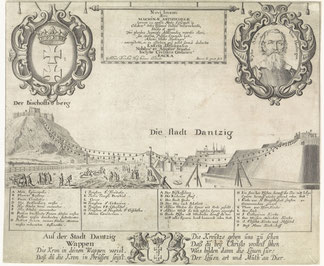
The world's first ropeway from Gdansk was built by Mr Adam Wybe, engineer and master builder, 1584 - 1653. In 1644 he had the task of building the city's suburban bastion (Bastion Berg). The material for this was quarried on the Bischofsberg opposite. The simplest version of the material ropeway was constructed with a single circulating rope. With this rope, from which 100 buckets were suspended, he connected the mountain and bastion across the Radaune Canal. The system was driven by a göpelwerk, which was set in motion by horses.
Aerobus from 1975 at the Federal Garden Show in Mannheim.
3. The overload days and planetary limits
3a. The overload days
There is Earth Overshoot Day, or the overload day, by which the resources of a year are used up. But it is recalculated every year, so on 1 January everything is back to zero, but is that right?
Of course not.
We have been using too much since 1970, 2 days in 1970, 151 days in 2023, 5,108 days in total so far, so today we are using the resources from July 2037.
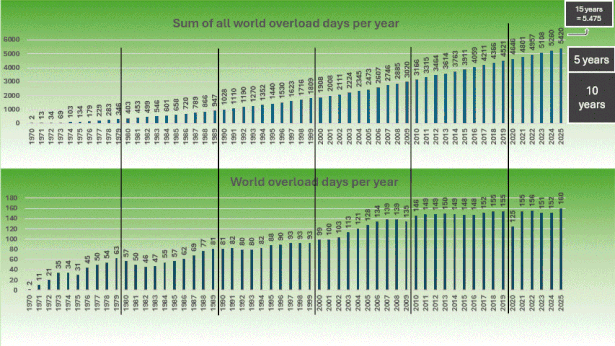
One more note on this topic:
We had 30 fewer overload days in 2020 than in 2019 due to the global lockdown.
However, we had the same figure again in 2021 as in 2019 and one day more in 2022.
In 2025, we have now used 160 days too many. That's 8 days more than last year.
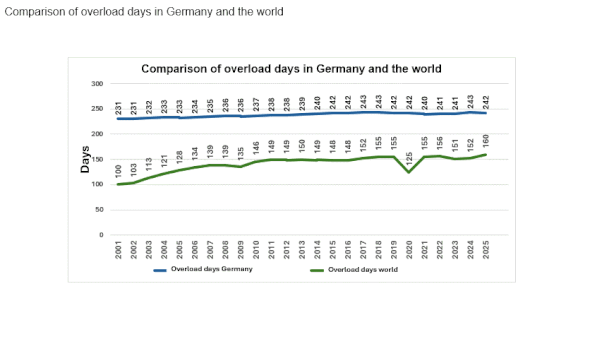
A comparison of congestion days from 2000 to 2025 between Germany and the world.
Data from Germany comes from a query via ChatGPT, as no other data is available yet.
Germany remains almost the same, but the data for the world is increasing.
JM 06.05.2025
3b. The tipping points (planetary boundaries)
Our planet has limits in terms of air pollution, biodiversity, the extent of climate change and other areas. Limits that must be observed in order to preserve the basis of human life. The concept of planetary boundaries defines these guard rails. It now encompasses ten dimensions that are crucial to the health and viability of our human civilisation.
We have now passed 7 of the 10 tipping points.
The average value of all tipping points is
175 %, i.e. exceeded.

4. Climate reports and climate impact costs
4a. Climate status report 2024
4b. Report of the German Weather Service 01.04.2025
Excerpt from the content:
Germany is already experiencing serious consequences of climate change / DWD describes accelerated warming in Germany with new climate trend line.
The DWD will therefore be using a new climate trend line in future, which can depict the recent accelerated rise in temperature much better. The result of the new method is sobering.
Germany has already warmed by 2.5 ⁰C compared to the early industrial era.
“The DWD has not remeasured, the world is the same as before. However, the reality, and this mainly concerns the accelerated warming, is now better described.”
JM 14.04.2025

Here is more data from CHAT GPT:
Country / region Temperature rise (compared to pre-industrial times)
Germany +2.5 °C (DWD, 2024)
Austria +2.4 °C (ZAMG, 2023)
Switzerland +2.5-2.8 °C (MeteoSchweiz, 2023)
Scandinavia +2.0-2.5 °C (Sweden, Norway, Finland)
Canada (North) +3.0-4.0 °C (mainly Arctic regions)
Russia (Siberia) +3.0 °C (some regions partly above 4 °C)
Arctic as a whole +3.0-4.5 °C (fastest warming worldwide)
JM 24.06.2025
4c Graphics from Copernicus 2025
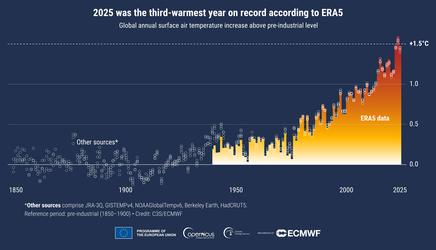
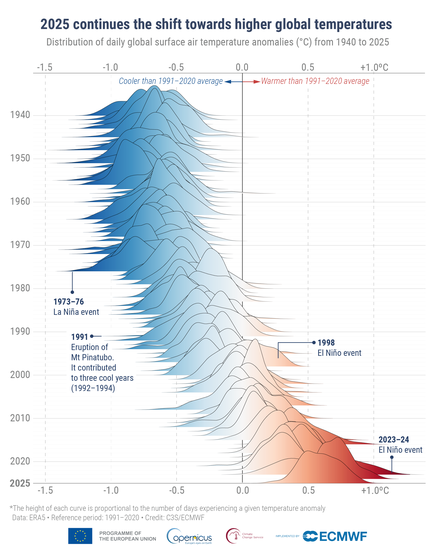
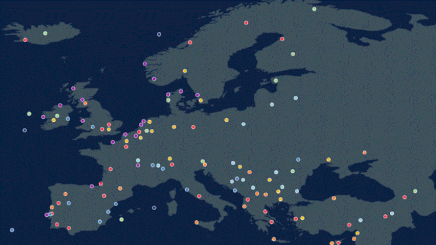
Copernicus: European Climate Status – Key Events in 2025
Select an icon to explore specific events that characterised Europe in 2025. Icons are colour-coded by event type and those referring to the same event are highlighted together on hover.
4d. Lecture on the state of the climate by Prof Harald Lesch
Das Video zu Vortrag:
4e. Interview with Karsten Schwanke (Aug. 2025)
Meteorologist Karsten Schwanke: “Germany is not prepared for what is coming” (in German)
JM 12.08.2025
4f. Report on climate impact costs
32 trillion dollars in damage per year: the global economy has already committed to a 17% loss of income due to climate change.
Correction Report dated 6 August 2025
JM 11 November 2025
Human-induced climate change comes at a huge cost: between €280 billion and €900 billion by 2050. This is the finding of a recent study commissioned by the Federal Ministry for Climate Protection and supported by the Federal Environment Ministry. The study analyses the current and future costs of climate change for Germany.
Weather disasters are costing the world's largest economies more and more money – and thus prosperity. A recent analysis by Munich Re shows that in eight of the ten largest industrialised countries, damage caused by natural disasters measured in terms of gross national income (GNI) is now significantly higher than in the 1980s. Over the past five years, it has been particularly high on average in the USA, Germany and India.
The analysis was published ahead of the COP 30 climate summit in Brazil and highlights how extreme weather events are affecting the economic substance of even the largest industrialised countries.
JM 13 November 2025
5. Nature and its monetary value
5a. Nature, the value of a tree and replacement planting
A calculation from part of a new industrial estate. Only 35 trees were calculated. The diameter and the crown diameter were specified. The costs and replacement planting are calculated from this
and the data from the two links.
35 trees with a total of
6,104 years of life cost
9.1 million EUR required
122,083 replacement trees on
180 ha planting area.

When valuing new building land, the value of nature must therefore be assessed accordingly and included in the calculation. Here are important values for these calculations:
Value of the tree,
Performance of the tree,
leaf area and number of leaves.
The value of the soil could not yet be determined.
Excerpt: Therefore, plant the oak in a place where there is no other tall tree or shade from houses within a radius of at least 15 metres. Young trees can be planted in spring or autumn. Loosen the soil in the planting hole thoroughly.
5b. Nature, the creation of topsoil
Our topsoil is important and also finite. The Federal Environment Agency shows us why:
The finite topsoil:
‘It can take between 100 and 300 years for a one-centimetre-thick layer of humus-rich soil to develop - but it can be lost to erosion in a single heavy thunderstorm.’
Topsoil is created in a hall over the 150 years. This means that 3 generations are employed.
The cubic metre of topsoil then costs approx. 450,000 EUR.
6. Global sovereign debt
Die globalen Staatsschulden belaufen sich z.Zt. auf ca. 100 Billionen Dollar.
Die Schulden incl. der Privathaushalte und der Unternehmen belaufen sich auf ca. 282 Billionen Dollar in 2020.
7. Global monetary policy
Current monetary policy is based on assumptions that were developed in a world without a climate crisis and scarcity of resources. A fundamental rethink is necessary in order to create ecologically and socially sustainable societies in the long term. This means that we need to rethink our relationship to money, growth and debt in order to meet the challenges of the 21st century.
The 38 trillion dollar loss per year from point 10 is shown here.
This means that per capita debt will be 210,000 dollars in 2050.
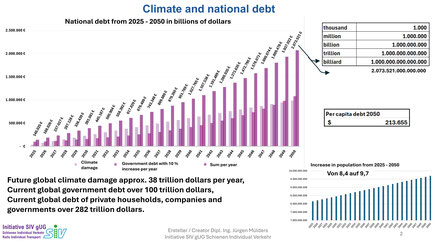

The sums shown here are unimaginable, but unfortunately they will probably come true.
In 2050, we will be around 9.7 billion people with a debt of 2 quadrillion dollars.
That corresponds to 213,000 dollars per person.
In Germany, public debt will have doubled from EUR 1.2 trillion in 2000 to EUR 2.4 trillion by 2023.
8. Eight questions to three AI systems for the survival of mankind
9. Conclusion
We've all been on board the Titanic since about 1970.
About 20 years ago, we rammed the iceberg – the climate problem has long been a reality.
But instead of acting decisively, we argue about who should pay the bill for the food.
Shouldn't we finally start repairing or at least containing the damage?
If we don't manage to do that, the bills will be superfluous,
because there will be no one who can pay them.
We have now bought a new ship, the Exodus from 1947 and
have expanded it for 2 billion climate refugees.
If you find any errors, we are grateful for any advice.